Singleton Shmingleton - Arachnoid Adaptation
 Jesse Barker Plotkin
April 7, 2025
Find some arachnoid combat tricks up your sleeve with this technically playable brew!
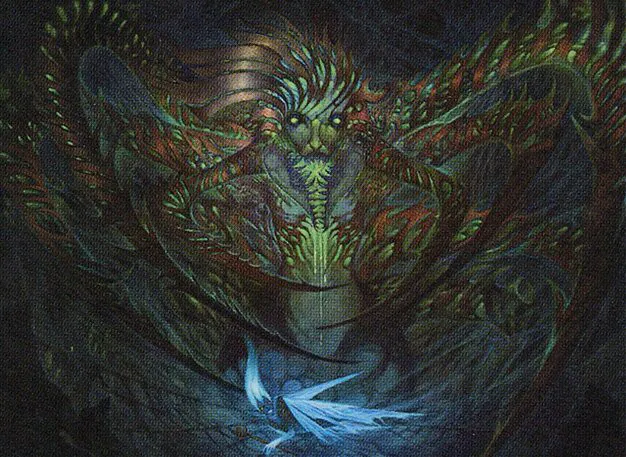
Arachnoid Adaptation | Art by Isis Sangaré
Get Ready to Twiddle!
Welcome back to Singleton Shmingleton, where I bend the singleton rules of Commander by building decks with as many functional reprints of a certain card as possible.
This week's card has almost never graduated from the forty-card deck to any format with sixty or 100 cards, but today I aim to give it its due.
Arachnoid Adaptation and its dozens of redundant versions are absolutely fine cards to play in Limited, in which their flexibility is enough to justify their inclusion, and the ambush they offer can even swing the entire tempo of the game.
But in higher-powered formats, creature combat is not as prevalent, and combat tricks don't hold up... unless you're using them for a different purpose.
Constructed decks that use combat tricks usually fall on the combo end of the spectrum. Given how rarely combat tricks matter for good old attacking and blocking, constructed decks use them on different axes.
Infect decks in various formats accept the card disadvantage of cards like Scale Up and Vines of Vastwood and try to use them to give an opponent ten poison in one turn.
Zada, Hedron Grinder decks in Commander use combat tricks that cantrip, such as Expedite, to make tons of copies and draw tons of cards.
These decks focus on special combos, and often focus on using a specific part of the combat trick. And this week's deck will do the same thing. But what is the specific part of the combat trick that we'll use?
Well, with Arachnoid Adaptation, we'll be trying to abuse the ability to untap a creature.
There are twenty-nine instants and sorceries for two mana or less that untap a creature and pump it. Almost all are in green and white, and some are so similar that I'm amazed they weren't just printed with the same name. Here they are:
Arachnoid Adaptations

The most played of these cards, in 41,940 decks, is the only blue card on the list in Shore Up. This card gives the additional bonus of hexproof, which is certainly a big game, but unfortunately won't fit into our deck.
The next most played card on the list is Gift of the Viper, in 38,764 decks. It's a classic example of Modern Horizons power-pushing, as everything it gives is a permanent counter (which is especially enticing for all the Skullbriar, the Walking Grave players who run the card). The least played card is Defiant Stand, which combines an inefficient rate with a weird timing restriction.
No thank you to that! But the second least played card is at least interesting. Hope and Glory only sees play in 209 decks, but it untaps two creatures, and it also has beautiful Heather Hudson art that makes it a fine include even if you just keep it in your hand to look at.
Out of the total card on the list, fifteen cost one mana and fourteen cost two. If we're going to build an engine out of these cards, we'll want to focus on the cheaper options, and just add a sprinkle of the more expensive versions.
C-C-C-Comboooo!
Looking on the Top Commanders page for Arachnoid Adaptation shows two exciting legends that synergize incredibly well with it: Marwyn, the Nurturer and Selvala, Heart of the Wilds.
Both of these creatures can tap for mana equal to their power, and Arachnoid Adaptation can untap them and increase their power.
If we can consistently control one of these supercharged mana dorks, then our combat tricks can act almost as super-rituals that add increasingly large amounts of mana.
If Dark Ritual and Cabal Ritual are strong enough to power storm decks in Pauper and Legacy, imagine what we can achieve with a deck full of spells that can pay for themselves six or seven times over.
These two creatures are a start, and I've chosen Marwyn, the Nurturer as our commander, but we get even more redundancy in case our opponents (rightly) target our mana engine.
Kami of Whispered Hopes, Viridian Joiner, and Cradle Clearcutter all give us the same effect for three mana, and the new Rainveil Rejuvenator backs up the team in the four-drop spot.
Storm decks require two things: mana and card draw. We've created an absurdly explosive mana engine, and now we have to find the card draw that best fits with it.
Mono-green isn't known for its incredible selection of card draw spells (nor for its storm decks, though 568 of you are barking up a similar tree), but there are some cards that fit into this combo perfectly. Soul's Majesty, Rishkar's Expertise, Return of the Wildspeaker, and Season of Gathering can all draw cards equal to a creature's power.
This lets us take advantage of the huge creature we already have built, and will hopefully draw us into more of our combat tricks to make even more mana.
Adding Consistency
We've already found our core engine, but that won't be enough to sustain itself for the huge turn that storm decks require. Luckily mono-green has another powerful and popular pseudo-storm strategy that overlaps with our commander: Elf Ball.
Elf Ball seeks to play tons of Elves that make loads of mana, play cards that draw more cards for controlling a huge board of creatures, rinse, and repeat.
And Marwyn, the Nurturer rewards us handsomely for doing exactly that. Along with some bread and butter Elf staples like Llanowar Elves, Elvish Visionary, and Reclamation Sage, some creatures complement our strategy perfectly.
Timberwatch Elf and Immaculate Magistrate help us grow our commander by pumping it for each Elf we control. This can turn our Arachnoid Adaptations into even more ridiculous rituals, netting upwards of ten or fifteen mana.
And speaking of rituals, Quirion Ranger, alongside honorable Elves Scryb Ranger and Wirewood Symbiote, can give us extra untaps on our mana creature while also slotting into the Elves package seamlessly.
Our deck is already built to take advantage of creatures that tap for tons of mana, and there are a few Elves that can take the spot of our Marwyn, the Nurturer or Viridian Joiner in a pinch. Elvish Archdruid and Priest of Titania can easily tap for five mana, which is enough to make our Arachnoid Adaptations broken even if we don't care about the power boost. Circle of Dreams Druid joins these classics as an even more ridiculous mana-maker in a deck that runs a good number of non-Elves.
The go-wide Elves package unlocks some more of green's most powerful draw engines to churn through our deck. Shamanic Revelation, Collective Unconscious, and Regal Force draw a card for each of our creatures, which lets us cast even more creatures.
We can also play our draw engines before our creatures, since Beast Whisperer and Soul of the Harvest let us draw cards for everything we cast after them.
Going Infinite
We now have a combo deck that relies on creatures that tap for a lot of mana. We're not looking to build advantage slowly and fairly; we want to start and not stop until everyone else is dead. Why not embrace the combo and include a few cards that can go all the way, generating infinite mana?
Umbral Mantle lets us repeatedly untap our creature for only three mana, so as long as it taps for at least that much, we can do it as many times as we want. It even boosts the power if we're using Marwyn, the Nurturer or another version of her.
Staff of Domination requires the creature to tap for slightly more mana before we break even, but it also gives us the payoff for our infinite mana, drawing our whole deck, tapping down everyone's board, and giving us infinite life.

Winning the Game
The goal of the deck's engine is to keep accelerating until we can find every card in our deck and have virtually (or literally) limitless mana.
If this succeeds, then we can win using a combination of three cards, each of which has added benefits in other scenarios. Walking Ballista turns mana into direct damage, and has the upside of being lethal as soon as we find infinite mana, even if our draw engine didn't come together.
Craterhoof Behemoth is the classic green finisher, and can end a game even if we never establish more than a few creatures. And Finale of Devastation is an infinite mana sink that doubles as a creature tutor when we're building up to the combo turn.
It's possible that we fizzle out on our storm turn, however, and can't see our whole deck. There might be nothing we can do if we draw ten lands off of a Rishkar's Expertise, or if an opponent counters a crucial Burst of Strength. But the nice thing about our engine is that it's built on a fundamentally powerful core of Elves.
Even if our big turn doesn't end the game, it still usually draws us a whole bunch of cards and put several more creatures into play. Elves is a tried and true strategy, and friction just changes our deck from a combo strategy to a high-synergy pile.
The Decklist
Mono Green Draft Chaff Storm
This deck is a blast to play. I love playing combo decks every so often, and this deck scratches the itch of solving puzzles and maximizing mana. Being mono-green gives this deck its own feeling, since green has its own unique strengths and weaknesses.
It can make insane amounts of mana very quickly, and cards like Regrowth are better than any other color's spell recursion, but the card selection is just not as strong as a color like black or blue.
Of course, it also delights me to no end to build an unstoppable force using cards like Cradle Clearcutter and High Stride that my opponents have to read when I cast them.
The reason I play combo decks is because I like feeling like a mad genius now and again, and nothing makes me feel more madly ingenious than combining two terrible cards to make something unexpected. This deck illustrates the power of redundancy over raw power, and that's what I set out to explore in this series.
Until Next Time
This is an absolute classic, dating back to the very beginning of the game. It has been re-interpreted dozens of times, in different forms, and has always been... fine. How can we make something powerful out of one of the least broken cards out there? Find out next time on Singleton Shmingleton!