Singleton Shmingleton - Fireball
 Jesse Barker Plotkin
January 27, 2025
Let's see how strong an EDH deck can be when it's built around variations of on of the oldest Magic cards, Fireball.
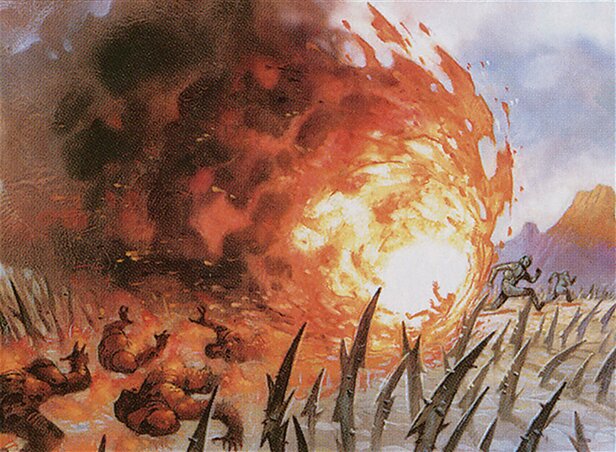
| Art by Dave Dorman
Great Balls of Fire!
Hello, and welcome back to Singleton Shmingleton, where I bend the singleton rules of Commander by building decks with as many functional reprints of a certain card as possible. This week's card is one of the most iconic spells in the game, dating back to Magic's first set and even earlier to the iconic D&D wizarding specialty from which Magic drew much of its aesthetic inspiration. It's .
This card is simple and evocative: channel (or perhaps even ) your mana into this spell, and the more mana you have, the bigger it gets and the more things it can kill.
Players loved it. It ended games at all levels of competitiveness, and was part of the iconic combo that gave its name to one of the most influential brands and testing teams in Magic's history. Alongside and , it was the card that ended games.
has remained a popular design to return to again and again, with dozens of X-spells that deal damage. They've been important role players in Standard combo or ramp decks, and have captivated more casual players for thirty years.
For a long stretch of time, " with set mechanic" was a good bet to fill a rare slot in any upcoming set. There are so many derivations that I've limited the search to only cards that can deal damage to creatures and/or players, as these capture the flexibility of offense and defense that made the original such a force to be reckoned with.
Here are the thirty-eight spells that deal X damage to a target:

The most played of these cards, , sees play in 68,449 decks and is a bit of a throwback. It's similar to in that you can pay extra mana to do damage to more things, but instead of splitting the damage it just does the full X to everything you target. It's an expensive way to solve any number of problems, from any number of creatures to killing opponents outright, and I'm glad that it still shows up here.
The next most played card is , which sees play in 59,814 decks and is a finisher for the modern era. If you're dumping mana into it, it scales up fast. Five times X is no joke. , the third most played card in 46,983 decks, also provides an elegant finisher in a format where there are usually exactly three opponents.
The least played of these cards is , with only 172 decks. This is a real stinker; it can only target players, but that player can redirect the damage to their least valuable creature. Even flashback can't redeem it. The next least played card, however, is actually one of my favorites. is only included in 193 decks, but it can do everything, hitting creatures and players and even drawing cards! It costs a million mana, sure, but if we're filling our deck with X spells, surely we'll have a plan for that.
Learning From Experience
Looking at all of these cards immediately brought me back to one of the first Commander decks I built: . She works so well with X spells, because they will always have a higher mana value than your experience, even if we don't put any mana into X, and the amount of discount we can accumulate on spells throughout a game can become ridiculous.
This was the first deck I built where the concept worked too well. I filled the deck with cards like and , and basically drew my whole deck every game. Add in as a way to untap all my lands, a few ways to return and play it again, and what I thought would be an interactive Spellslinger deck became a solitaire-style Storm deck. Don't get me wrong, I love playing combo decks, but that wasn't my intention, and it wasn't the kind of game I had told my friends I would be bringing.
But today, I have the chance to recreate this deck as I originally intended. The problem with playing fifteen versions of that can all be cast for two mana is that each one becomes more and more likely to find another one, and the chain never ends. doesn't have the same problem. Each one fuels the next in that it will give you an experience counter with on the board, but it doesn't also dig for more s. solves the fundamental problem of huge X spells by providing an ever-increasing discount, but the game still feels like it revolves around casting huge spells and interacting with opponents' boards, rather than calculating combo math.
There are a couple other ways I've included to fuel huge X spells for redundancy. works very similarly to , but doesn't scale up quite as quickly. accelerates games into the haymaker stage almost instantly, but should benefit us the most since our spells can be as big as we want. And scales to be a crazy mana rock once we've cast a few X spells.
Nuclear Proliferation
Our primary way to power up our X spells, however, is definitely still . She gives us experience counters, which are very hard for our opponents to interact with, but can be easy for us to manipulate with a little deckbuilding consideration. Cards like , , and are all spells that can also proliferate, giving us more counters.
is especially powerful, since we can cast it for free if we have three or more experience counters thanks to its Phyrexian mana cost. goes off in this deck, since we're planning on casting tons of spells anyways. And I wanted to try out as well. Its trigger reminds me of , a card that has impressed me a lot (and which seems to trigger almost every turn), and the Whale is also just a huge body for its cost.
Spells that make s are also powerful in this deck as a way to chain spells or build up mana for a following turn. , , and are all great spells that play even better in this deck, as they can be mana-neutral or even generate mana if we have enough discount. remains one of the most powerful enablers for spell-based decks. And I've snuck in , which, despite only being able to target creatures, is one of the best s in the deck. Once we've got a good amount of discount, it can be a one-mana spell that kills a creature and gives us tons of Treasures for the next turn.
Oiling the Gears
We need some way to get our motion started if we want to build up to lethal s. It's a bit disappointing to have to start with a for one just to gain some experience. Thankfully, blue and red have some of the very best instants and sorceries for card selection in the game.
, , and can gain experience counters while also looking for slightly larger spells to trigger 's ability again. Further up the chain, cards that can be cast for free, like and , can notch up the experience as well. can be a two-mana draw-three while also having the flexibility of just being part of our mana base.
I also simply could not resist adding in some of the explosive elements of the original Storm deck. For the draw spells, I chose to include only the best, which in this deck means only the ones that can be discounted to a single mana. , , and all join our little package of and for draw power. and remain powerful ways to generate mana, and the new can draw huge chunks of our deck.
The key with these cards is to make sure they're not the centerpiece of the deck. With only a few of them, we won't have the same chance of chaining one into the other, and our s can shine as the lynchpin of the strategy.
The Decklist
Disco Inferno
This deck is a blast to play. Our twenty-three s give us a high level of consistency, but each individual version brings its own flavor to the game. plays out totally differently from , leading to different games. We can also shift very quickly from offense to defense and vice versa, since can function either as removal or half of an "I win" button.
is fundamentally a messed up engine for discounting spells, and sometimes we'll draw two or three ways to build huge card advantage along with our mana advantage, but in this deck it feels more like the classic explosive potential of a Spellslinger deck, rather than a concentrated strategy to end the game in one turn. In terms of reworking the vibe of a prior deck, this was definitely a success.
Until Next Time
One of the best build-arounds of all time, is a card that has always inspired dreams. But there are now seven versions of this effect. That's enough that we can now base a strategy on finding one every single game, and accumulating masses of tokens! How can we maximize one of the coolest cards in the game? Find out next time on Singleton Shmingleton!