Singleton Shmingleton - Oblivion Ring
 Jesse Barker Plotkin
September 23, 2024
Don't blink and miss this enchantment-based control deck!
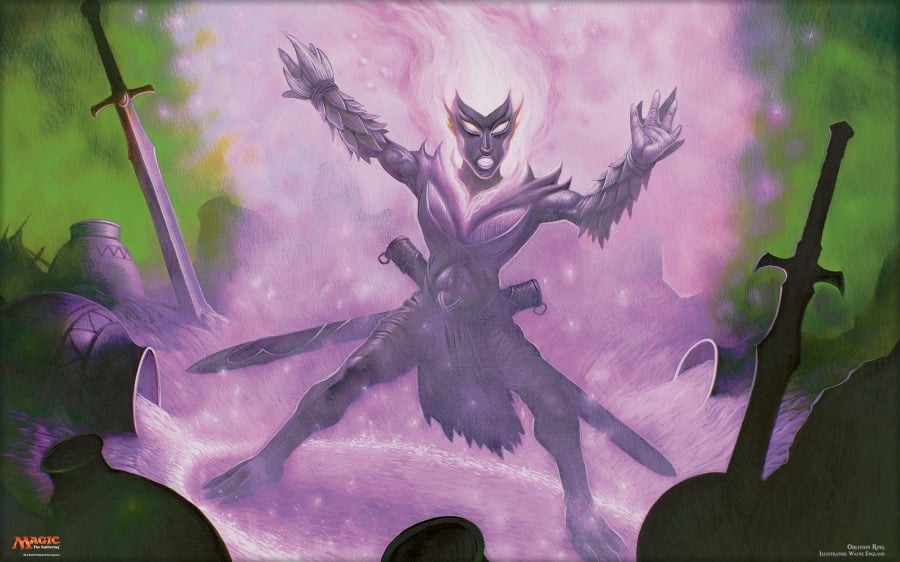
( | Art by Wayne England)
Ring Ring Ring!
Hello, and welcome back to Singleton Shmingleton, where I bend the singleton rules of Commander by building decks with as many functional reprints of a certain card as possible.
This week, we're looking at one of the foundational templates for white removal spells in .
Whether it's efficiently gaining advantage in a game of Limited, synergizing with enchantment synergies in Commander, or providing one of the first viral moments in Magic content by breaking MTGO, and its descendants are woven into the fabric of Magic at this point.
We get a new version of this effect in almost every set, and each one finds a home.
The most recent versions of this template to break into eternal formats are and , but s have often been the defining removal spells in Standard control decks, and has been a pillar of Pauper since Zendikar.
The design of has persisted and flourished because of its elegance. For a relatively cheap cost, it allows you to entirely get rid of a threat, but it comes with a liability.
If your opponent can manage to remove your enchantment, the threat returns, and brings any enter-the-battlefield triggers it may have with it. Early versions of this effect had two separate triggers, meaning that if you could remove your own before its first trigger resolved, the second trigger would return nothing and the first trigger would exile the threat forever.
This play pattern is unintuitive and doesn't play out the way the card was designed, so later cards such as use a simpler wording that prevents such shenanigans.
The vast majority of s use this second templating, so if we want to abuse these cards, we're going to have to find a different way.
There are dozens of cards that exile a permanent when they enter the battlefield and return it when they leave. I chose to include only the ones that can be played for three mana or less, because we have enough options there that we simply do not need to play any of the more expensive ones.
I am, however, including , because the art is gorgeous and the cycling ability makes it "playable" for one mana. Even with these restrictions, I found 38 iterations on . Here they are:

The most played of these cards is , in 62,785 decks. I remember the wild levels of hype when this card was printed, and it has continued to deliver for a decade now. Getting a three-for-one exiling removal is still a ridiculous deal.
The next most played card is in 37,696 decks, which has the added flexibility of being able to be Channeled as a .
The third most played is in 28,446 decks, followed by itself in 27,461 decks.
These cards have stood the test of time because of the trickery that is made possible by the separate triggers that exile and return the card you want to remove.
The least played card is actually the oldest: from all the way back in Ice Age, with 180 decks to its name. This card is sadly made terrible by its upkeep cost of three mana, but I'm glad this design was revisited eventually, because without that upkeep cost it becomes an extremely iterable template.
Hello, Oblivion Speaking
So, we've filled our deck with efficient removal spells. Now what? We've determined that not enough of our s have the old templating that allows us to respond to the first trigger by removing our enchantment to exile a card permanently, so we'll have to look further.
The next place my mind turned in order to turn these cards into more than the sum of their parts was any way to interact with the cards they exile. If we could somehow move those cards, we could or otherwise re-use our s to permanently exile multiple cards.
Luckily for us, there is a small but very neat group of cards that removes cards from exile: the Eldrazi from Battle for Zendikar. Cards like , , and fit perfectly in this deck as ways to get value off of the cards we've exiled while also opening up our enchantments for re-use.
Unfortunately, these three cards are among the best we're going to find with this mechanic.
I remember it being somewhat difficult to put together a good Limited deck in that set using these slower Eldrazi, and translating that into 100-card singleton might be difficult.
We definitely need to play some cards that I've never even considered in Commander, such as , but hey, that's the beauty of the format. and , two cards I wrote off years ago, become the best of the bunch in this deck as a way to repeatedly return exiled cards to graveyards.
and are serviceable removal, and even makes the cut as a big way to "Process" cards we've exiled.
Most of these cards trigger when they enter the battlefield (just like our s!), so any way to Blink them in and out of the battlefield will be extremely valuable.
We're already in white, blue, and black, so is a perfect commander for us.
Her +1 is generically useful, and the -1 will let us recycle any of our or s. slots into the main deck, as do , , and the thematically appropriate .
And with that, we have an engine! and friends exile our opponents' permanents, and friends process the exiled cards, and and friends let us do it all over again.
Is Your Refrigerator Running?
Let's look at ways to supplement this engine. Alongside ways to blink our enchantments, there are also several ways to sacrifice them for value, and several ways to return them to the battlefield.
and let us turn our enchantments into cards, and lets us turn them into life. Once we've sacrificed them, we can use cards like , , and good ol' to return them to the battlefield and get another bite of their effects.
and let us sacrifice our as well, and when they get reanimated we can stack our triggers to process the cards we exile right away.
Alongside our little Eldrazi package, we get to run some of the lands that have made Eldrazi broken in other formats.
taps for two mana, which goes a long way in this mana-hungry deck, and discounts all our Eldrazi while also offering us a late-game repeatable tutor.
It doesn't tap for mana itself, but we're playing to mimic the old Modern deck's ability to turn it into an even more broken mana producer.
Unfortunately, the new doesn't fit in this deck, as we only have one card in the whole list that we can exile, but even just two broken lands go a long way.
Finally, we need a way to win the game. Our engine is, in essence, a way to create repeatable removal spells while gaining incremental value. Not only does this slow the pace of the game dramatically (in a multiplayer format that often slows down by itself), it also won't stop every deck.
Many decks devote most of their resources to building up a huge hand, or ramping out a ton of lands, or playing powerful instants and sorceries. They might not care at all about us using every turn.
So we need to apply some pressure before they can take advantage. does provide quite the clock, hitting opponents for almost a quarter of their starting life if unblocked, and can do a good job of going wide.
But if we're playing , why in the world wouldn't we play and as well? It's a perfect way to make a huge board out of nowhere, and our commander's +1 can set either one up as the top card of our library any time we find it in our hand.
The Decklist
Oblivion & Eldrazi
This deck is a breath of fresh air for any player who loves either traditional control decks or playing with terrible cards (or both!).
When you slam down a on turn four, people might laugh, but after you flicker it three times they'll put more respect on its name. Each piece of the engine buys more time to find the next piece, and the Eldrazi are beefy enough to hold their own in combat until a arrives.
The deck definitely feels like it revolves around our s, and the loop we create with them is novel enough and uses enough crazy cards to more than make up for any feel-bads that may arise from us trying to remove every threat our opponents play, over and over.
Until Next Time
Continuing in the line of enchantment-based removal, we're now moving into blue, with one of the most iconic card archetypes of all time. Swinging games in crazy ways since Alpha, lets us play with our opponents' toys while they watch with jealousy.
Or... at least I hope it will. What kind of shenanigans can we do with dozens of this effect? Find out next time on Singleton Shmingleton!