Singleton Shmingleton - Spider Spawning
 Jesse Barker Plotkin
February 10, 2025
Creepily crawl your way to victory with Spider Spawning!
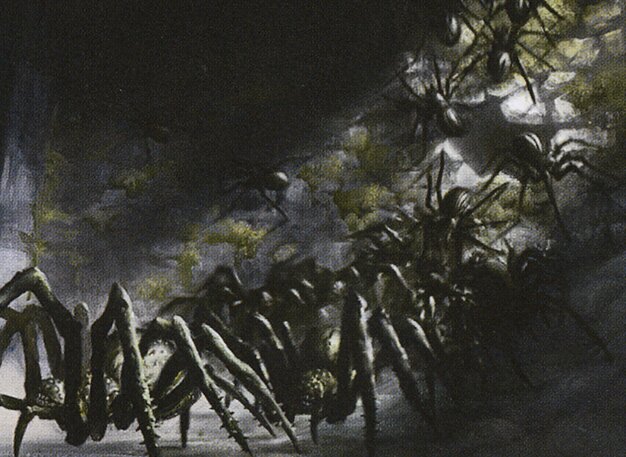
| Art by Daniel Ljunggren
Creepy Crawlies Galore!
Hello, and welcome back to Singleton Shmingleton, where I bend the singleton rules of Commander by building decks with as many functional reprints of a certain card as possible.
This week's card is a Hall of Fame build-around in Limited, a casual favorite, and a powerful game-ender in Commander. It's the creepy crawly army-in-a-can: .
This card has never seen competitive play, but it has become a legendary card for any graveyard strategy, and defined an archetype in Innistrad draft all by itself.
Alongside self-mill cards like and the card to re-use after it was flashed back, you could conceivably play the card every turn out of an otherwise empty library.
It was brought back in both Shadows Over Innistrad Remastered on Arena and in Innistrad Remastered, so that more players could experience the archetype.
Because of this card's popularity, we have gotten several cards that call back to it, but none of them has had the power of the original.
The trick is the sizing of the tokens. It is surprisingly difficult to get rid of a pile of 1/2s with reach.
If your opponent attacks with a 5/5 (even a 5/5 flyer), you can block with five of the tokens, and only lose two of them while killing a sizeable threat.
Even , which creates 2/1s at a cheaper rate, cannot compete with the stabilizing power of .
There are eleven cards that create creature tokens equal to the number of creatures on your graveyard. Most are in green and/or black, but one dips into each other color. Here they are:
Spiders Spawnings

The most played of these cards is , which sees play in 23,439 decks. Having this ability on a creature that can be d is huge, and the ability to gain card advantage is a plus.
The next most played is in 18,011 decks, followed by itself in 14,172 decks. having the ability to create tokens every turn is absolutely crazy, and it's a beefy threat in itself.
The least played of these cards (besides the not-yet-printed ) is , in 1,243 decks.
I'm not quite sure why this card is so low. It's one of the cheaper versions of this effect, and 2/1 tokens are quite a bit larger than the 1/1s produced by most of these cards. is the next least played card, in 3,211 decks.
It's still fairly new, but I'm excited about it as another version that can be flashed back. In a heavy self-mill strategy, that's a huge advantage.
One exciting aspect of this list is that it contains not one, not two, but three possible commanders. Given the color distribution of the rest of the list, we'll surely have to choose one of the black and green ones, unfortunately for .
And of the two remaining, I find 's pseudo- ability that also grows it to fit better with a plan of creating a bunch of tokens (many of which will be Insects) than 's incremental advantage option.
So the newbie takes the cake, presumably so that she can leave it out in the woods for a week and infest it with Insects.
Laying Our Spider Eggs
The first step of this strategy is to fill the graveyard. Cards like and are consistent ways to dump cards into our graveyard every turn.
is also an incredible way to dump our deck into the graveyard, and works very well with our masses of tokens.
Finally, is one of the most powerful self-mill cards of all time.
I'm not going to turn it into a one-turn mill everything engine by building the deck with zero basic lands, but even as a little guy that dumps about eight cards per turn in the bin and draws a land every turn, that's an incredible rate.
Given that we want our deck to include a ton of creatures, there are a few more that simply must make the cut. and mill us while replacing themselves, mills with unparalleled efficiency, and can help us early before turning into a huge threat late.
Creatures with Dredge are notorious for a good reason, and so , , and get the nod.
And finally, still feels underrated to me. It gives you repeatable ramp, tons of cards in the bin, and even a mana sink for later in the game.
How Far Can We Go?
Looking at many of these self-mill cards, a surprisingly large number of them also help us find extra lands. , , and double as first-rate ways to hit land drops turn after turn.
This got me thinking: if we want to have as many creatures as possible in our graveyard every game, how far can we go to use creatures as part of our mana base?
Given the other part of our plan is to resolve an expensive token-maker, we can't skimp too much, but there must be a balance, right?
The first step in this trimming is to include lands that count as creatures in the graveyard. is the only one that's both on one side, but cards like and also fit the bill.
There are now five of these cards in black and green, and in this deck we can use them as one-to-one replacements for lands, since we never care if we cast them (though we might if we do get flooded), but only care about the creature card type if they end up in our graveyard.
Of course we're going to want to include every one-mana mana dork we can, from the humble to the all-star .
Two of them that stand out especially in this deck are , because the number of lands that will end up in our yard give it a consistency it lacks in some decks, and the new , which can double as a mill engine if we're set on mana.
Now, the next group of cards is less universally praised. and are two-mana ways to search for lands on a creature, which is a better rate than it may appear, especially in a strategy designed around using lots of small creatures to good effect.
And , while its failure to actually replace itself and the fact that our opponents can also profit from it may dissuade many, can actually help in this deck, where cards like do so much more in our graveyard than in our hand.
None of these cards are exciting, but including all of them, alongside classics like , let us trim down to a measly twenty-six lands! That opens up room for more than half of the deck to be creatures, at fifty-four cards.
Spawning for Profit
So the first two steps of our plan are set: mill a ton of cards, most of which will be creatures; and cast a card that gives you that many tokens. Now we need to turn that plan into something that will win a game.
Our commander gives us a hint of one way to bring that about. makes each opponent lose life whenever one of her own Insects die, calling to mind Aristocrats strategies that try to combine effects with free sacrifice outlets like .
Both of the above mentioned cards make the cut in this deck, but we're going to keep this package fairly trim, adding only and for redundancy.
But we're also including a couple cards that can bring this whole combo together in one fell swoop. and can bring any two of these creatures that we've milled back into play using only a single card, and can even search up a missing piece if we haven't naturally milled both.
This gives us more space in our deck to focus solely on milling as fast as possible.
That win condition takes advantage of small reanimation spells, but we've also got lines involving bigger ones.
can be cast from our graveyard for free so long as we happen to have three creatures (such as, perhaps, 1/1 Insects or 1/2 Spiders).
Our primary targets are the infamous , capable of ending the game on the spot, and , if we need to control the board.
But even if we don't have either target in the bin, we can get quite a bit of value.
I've used creature cards for almost all of our interaction, from and to , and these cards can pull above their weight in a pinch as well.
But the dream with this deck is to have spells become almost like tutors that put cards directly into play because our whole deck is in the graveyard.
Notable Overperformers
: Not only does she count as a creature in the graveyard, she works very well with the tokens theme of the deck, and her Insect tokens synergize with .
: If we ever mill this card, our token army will be able to get through unhindered to anyone playing s.
While sometimes that won't mean anything, other times it will give us the ability to kill an opponent or two without us even having to spend a card on it!
: Not only is this a massive beater, it also works with our low land count and high number of expendable creatures to ramp us. This card is simply too efficient to pass up.
The Decklist
Turbo Spider Spawning
This deck is a blast to play, both because is awesome and because it feels so clever.
The mana base works well; though it leads to a few more mulligans than a forty-ish land deck because some hands will have two mana dorks and a but no lands, almost any hand that can cast a single spell will be just fine in terms of mana.
The high creature count makes our s scale up incredibly fast, and the fact that all our utility spells are creatures combines nicely with our s.
I worried that the plan would end up feeling the same every game, but one of the best parts of graveyard toolbox decks is that, because we never do have our whole deck in our graveyard, isn't a tutor, and it plays out differently every game.
Sometimes we beat down with our tokens over a few turns, sometimes we can make them huge and end the game all at once, sometimes we can assemble our Aristocrats package, and sometimes we need to get scrappy with a mix of all the different plans.
is the star of the show, and this deck really captures the excitement of casting that spell and counting how many tokens we get to make.
Until Next Time
This genre of creature has a cult following, and there are now fifteen different cards that will deal damage equal to the amount they receive.
How can we turn this from a deterrent into a gameplan? Find out next time on Singleton Shmingleton!